
Placement Metric
Highest Package
N/A
Represents the top salary package reported in the available placement information.

Massachusetts Institute of Technology has held the title of the world's #1 university in the QS World University Rankings for 13 consecutive years as of 2026. Founded in 1861 in Boston and relocated to its 168-acre Cambridge campus along the Charles River in 1916, MIT was built on a single, enduring idea: that science, technology, and hands-on problem-solving could transform the world. Its Latin motto, Mens et Manus — Mind and Hand — captures this philosophy precisely.
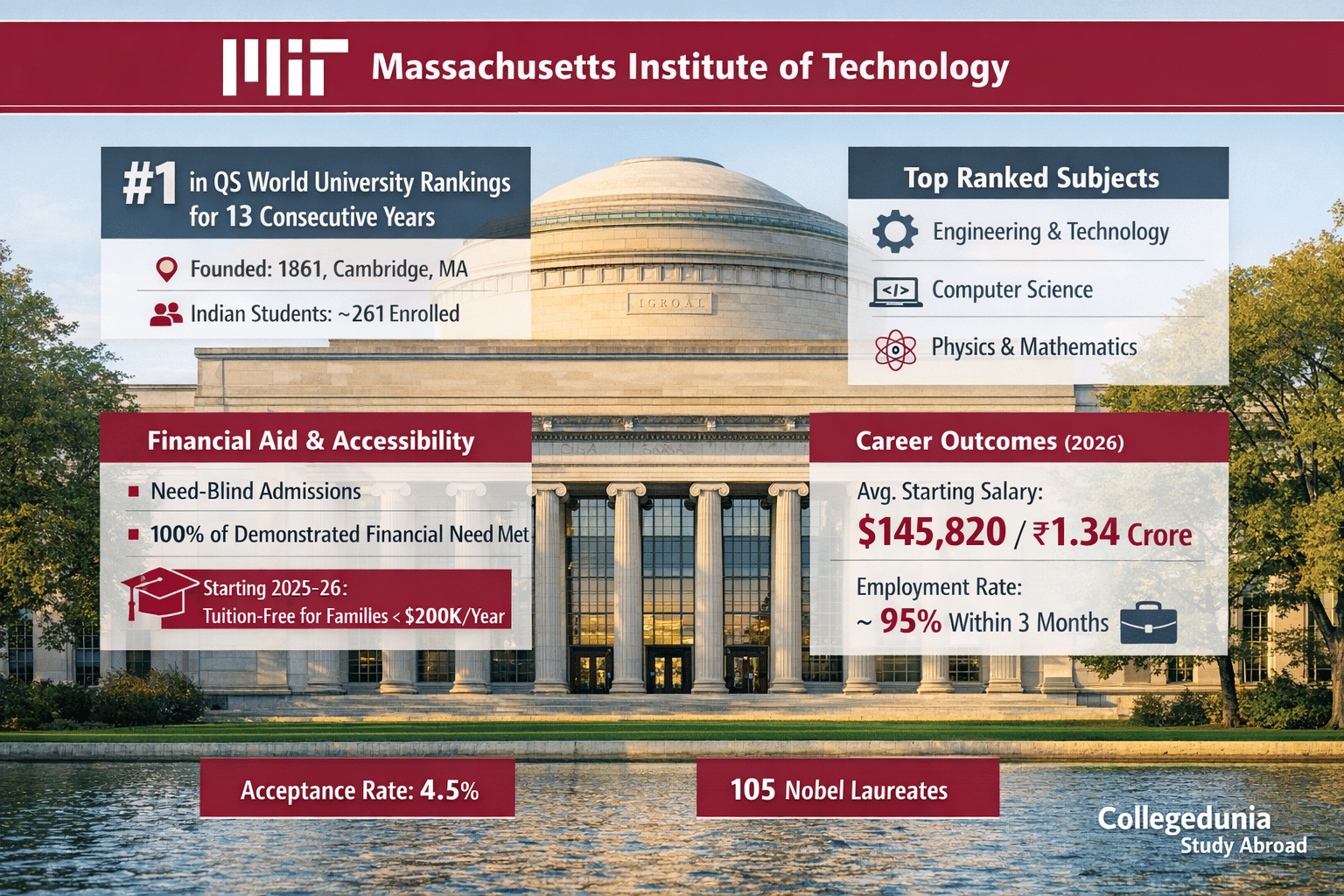
MIT is not simply a technology school. It houses five schools and one college spanning engineering, science, architecture, management, humanities, and social sciences. The institute is accredited by ABET (Engineering), AACSB (MIT Sloan School of Management), and NAAB (Architecture), and is a founding member of the Association of American Universities. With 105 Nobel Laureates, 84 MacArthur Fellows, and 65+ research centers including the MIT Media Lab, CSAIL, and the Koch Institute, MIT's academic depth is unmatched globally.
MIT's QS subject rankings for 2026 place it at #1 in Engineering & Technology, Computer Science, Physics, and Mathematics — the exact disciplines most sought after by Indian students. The average starting salary for MIT graduates entering industry stands at $145,820 (approximately ₹1.34 Crore), according to MIT's own Graduating Student Survey. For Indian students weighing the cost of an MIT education against long-term career outcomes, the return on investment is among the strongest of any university in the world.
| Parameter | Details |
|---|---|
| Established | 1861 |
| Location | Cambridge, Massachusetts, USA |
| Type | Private Research University |
| Total Enrollment | 11,886 (4,535 UG + 7,351 Graduate) |
| Indian Students Enrolled | ~261 (2025–26) |
| Acceptance Rate (UG, 2026) | 4.5% |
| UG Tuition 2025–26 | $64,310/year (₹59.17 Lakhs) |
| Total UG Cost of Attendance | $89,340/year (₹82.19 Lakhs) |
| Average Starting Salary | $145,820 (₹1.34 Crore) |
| Debt-Free Graduates | 87.7% (Class of 2025) |
| Primary Intake | Fall (September) |
| Application Fee (UG) | $75 (₹6,900) |
| Application Fee (Graduate) | 75–90; MBA: $250 |
MIT offers 114 programs across undergraduate, master's, and doctoral levels. The sections below present the most popular programs among Indian students, separated by level.
All undergraduate programs at MIT carry the same annual tuition of USD 64,310 (approximately ₹ 59.17 lakhs). The total cost of attendance — including housing, food, books, and personal expenses — is USD 89,340 (₹82.19 Lakhs) per year.
| Program | Annual Tuition (USD) | Annual Tuition (INR) | Duration | Key Entry Requirements |
|---|---|---|---|---|
| BS Computer Science & Engineering | $64,310 | ₹59.17 Lakhs | 4 years | SAT 1510+, TOEFL 100/IELTS 7.5, GPA 3.9 |
| BS Aerospace Engineering | $64,310 | ₹59.17 Lakhs | 4 years | SAT 1510+, TOEFL 100/IELTS 7.5, GPA 3.9 |
| BS Architecture | $64,310 | ₹59.17 Lakhs | 4 years | SAT 1510+, TOEFL 90/IELTS 7, GPA 3.9 |
| BS Physics | $64,310 | ₹59.17 Lakhs | 4 years | SAT 1510+, TOEFL 100/IELTS 7.5, GPA 3.9 |
| BS Chemical Engineering | $64,310 | ₹59.17 Lakhs | 4 years | SAT 1510+, TOEFL 100/IELTS 7.5, GPA 3.9 |
Check MIT courses and fees for Indian Students
MIT's master's programs vary in tuition depending on the school and program. The table below reflects 2025–26 annual fees.
| Program | Annual Tuition (USD) | Annual Tuition (INR) | Duration | Key Entry Requirements | Application Deadline (Fall 2027) |
|---|---|---|---|---|---|
| MS Electrical Engineering & Computer Science (EECS) | $64,310 | ₹59.17 Lakhs | 2 years | TOEFL 100/IELTS 7, GPA 3.5+, GRE 320+ | December 1, 2026 |
| MBA (MIT Sloan) | $89,000 | ₹81.88 Lakhs | 2 years | GMAT 730/GRE 311, TOEFL 90/IELTS 7, GPA 3.7 | Round 1: September 2026 |
| MS Business Analytics (MBAn) | $93,834 | ₹86.33 Lakhs | 12 months | TOEFL 100/IELTS 7, GMAT 700+, GPA 3.5+ | January 2027 |
| Master of Finance (MFin) | $93,834 | ₹86.33 Lakhs | 18 months | GMAT 700/GRE 260, TOEFL 100, GPA 3.5+ | January 2027 |
| MS Mechanical Engineering | $86,530 | ₹79.61 Lakhs | 2 years | TOEFL 100/IELTS 7, GPA 3.5+, GRE 320+ | December 15, 2026 |
| MS Economics | $86,530 | ₹79.61 Lakhs | 2 years | TOEFL 100/IELTS 7, GPA 3.5+, GRE 320+ | December 15, 2026 |
| Master of Architecture (MArch) | $86,530 | ₹79.61 Lakhs | 42 months | TOEFL 100/IELTS 7, Duolingo 135, GPA 3.5+ | January 7, 2027 |
| MS Engineering Management | $86,530 | ₹79.61 Lakhs | 1 year | TOEFL 100/IELTS 7, GPA 3.5+ | December 2026 |
| MS Civil & Environmental Engineering | $86,530 | ₹79.61 Lakhs | 2 years | TOEFL 100/IELTS 7, GPA 3.5+, GRE 320+ | December 15, 2026 |
| MS Chemical Engineering Practice | $86,530 | ₹79.61 Lakhs | 2 years | TOEFL 100/IELTS 7, Duolingo 135, GPA 3.5+ | December 1, 2026 |
MIT PhD programs are typically fully funded — students receive a full tuition waiver plus an annual stipend of approximately 38,000–42,000 (₹34.96–₹38.64 Lakhs). This makes a PhD at MIT financially accessible for Indian students with strong research profiles.
| Program | Funding Status | Annual Stipend (USD) | Annual Stipend (INR) | Duration | Application Deadline |
|---|---|---|---|---|---|
| PhD Electrical Engineering & Computer Science (EECS) | Fully Funded | ~38,000–42,000 | ₹34.96–₹38.64 Lakhs | 4–6 years | December 1, 2026 |
| PhD Computer Science (via EECS) | Fully Funded | ~38,000–42,000 | ₹34.96–₹38.64 Lakhs | 4–6 years | December 1, 2026 |
| PhD Mechanical Engineering | Fully Funded | ~$38,000 | ₹34.96 Lakhs | 4–6 years | December 15, 2026 |
| PhD Chemical Engineering | Fully Funded | ~$38,000 | ₹34.96 Lakhs | 4–6 years | December 1, 2026 |
| PhD Physics | Fully Funded | ~$38,000 | ₹34.96 Lakhs | 5–6 years | December 15, 2026 |
MIT offers a single annual intake — Fall (September). There is no Spring intake for any program. The table below summarises key upcoming dates for Indian students.
| Program Level | Deadline Type | Date | Status |
|---|---|---|---|
| UG (Class of 2030) | Early Action | November 1, 2026 | Upcoming |
| UG (Class of 2030) | Regular Action | January 1, 2027 | Upcoming |
| UG Financial Aid (CSS Profile) | Financial Aid | February 15, 2027 | Upcoming |
| MBA (MIT Sloan) | Round 3 (2026 intake) | April 6, 2026 | Last chance for 2026 |
| MS EECS / Most Graduate Programs | Fall 2027 | December 1–15, 2026 | Upcoming |
| MArch | Fall 2027 | January 7, 2027 | Upcoming |
| PhD Programs (most departments) | Fall 2027 | December 1–15, 2026 | Upcoming |
What's Next for Indian Students:
- UG applicants: Begin preparing SAT/ACT scores, essays, and teacher recommendations now for November 2026 Early Action.
- Graduate applicants: Most Fall 2026 deadlines have passed. Focus on Fall 2027 applications opening September 2026.
- MBA applicants: MIT Sloan Round 3 (April 6, 2026) is the last opportunity for the 2026 intake.
- PhD applicants: Applications for Fall 2027 open September–October 2026 across all departments.
Check admission process and requirements for international students at MIT
Indian students applying to MIT for undergraduate programs must meet the following criteria:
| Requirement | Details |
|---|---|
| Bachelor's Degree | Equivalent to a US bachelor's degree; GPA 3.5/4.0 (90%+) |
| GRE | Required for most programs; 320+ recommended (330+ for PhD) |
| GMAT | 700+ for MBA, MFin, MBAn |
| TOEFL iBT | Minimum 100 (some departments accept 90) |
| IELTS Academic | Minimum 7.0 (some departments require 7.5) |
| Duolingo | 135 (accepted by select departments) |
| ELP Exemption | Automatic exemption if English is your primary language OR if you completed a 3–4 year undergraduate degree in Australia, Canada, Ireland, New Zealand, UK, or USA within the last 5 years |
| ELP Waiver | Some departments consider waivers; policies vary by department — check individual program pages |
| Statement of Purpose | Required for all graduate programs |
| Letters of Recommendation | 3 letters (academic/professional) |
| Application Fee | 75–90 (most programs); $250 (MBA) |
Indian students who completed their undergraduate degree in India (even at IITs or IIMs) are not automatically exempt from the TOEFL/IELTS requirement. An ELP test score is mandatory unless a department-specific waiver is granted.
MIT is one of the most selective universities in the world. The acceptance rate has declined steadily over the past three years, reflecting growing global demand.
The table below shows the 3-year acceptance rate trend for MIT's undergraduate program.
| Year | Applications Received | Students Admitted | Acceptance Rate |
|---|---|---|---|
| 2024 (Class of 2028) | 26,914 | 1,291 | 4.8% |
| 2025 (Class of 2029) | 28,232 | 1,284 | 4.55% |
| 2026 (Class of 2030) | ~29,000 (est.) | ~1,275 (est.) | ~4.5% |
Realistic Perspective for Indian Students: MIT looks beyond grades and test scores. Research experience, intellectual curiosity, demonstrated impact, and authentic essays carry significant weight. Many successful Indian applicants have strong STEM Olympiad backgrounds, published research, or exceptional extracurricular achievements.
Check MIT acceptance rate trends and how to increase your chances of admission.
Understanding the full cost of attending MIT is essential for financial planning. All figures below are sourced from MIT Student Financial Services (sfs.mit.edu) for the 2025–26 academic year. Exchange rate: 1 USD = ₹92 (Wise.com, March 16, 2026).
| Expense Category | Annual Cost (USD) | Annual Cost (INR) |
|---|---|---|
| Tuition | $64,310 | ₹59.17 Lakhs |
| Student Life Fee | $420 | ₹38,640 |
| Housing (on-campus double, max) | $13,614 | ₹12.52 Lakhs |
| Food (max meal plan) | $7,650 | ₹7.04 Lakhs |
| Books & Course Materials | $910 | ₹83,720 |
| Personal Expenses | $2,436 | ₹2.24 Lakhs |
| MIT Student Health Insurance (SHIP) | $4,572 | ₹4.21 Lakhs |
| TOTAL (with SHIP) | ~$93,912 | ~₹86.40 Lakhs/year |
Note: Health insurance (MIT SHIP) is automatically included in tuition for UG students. The USD 64,310 tuition figure includes basic health coverage. The SHIP premium of $4,572 applies to graduate students paying separately.
| Expense Category | Annual Cost (USD) | Annual Cost (INR) |
|---|---|---|
| Housing (on-campus efficiency) | $23,076 | ₹21.23 Lakhs |
| Food | 5,000–7,000 | ₹4.60–₹6.44 Lakhs |
| Transportation (MBTA pass + misc) | 1,200–1,800 | ₹1.10–₹1.66 Lakhs |
| Books & Supplies | ~$1,000 | ₹92,000 |
| Personal & Miscellaneous | 2,000–3,000 | ₹1.84–₹2.76 Lakhs |
| MIT SHIP (Graduate) | $4,572 | ₹4.21 Lakhs |
| TOTAL LIVING (Graduate) | ~36,848–40,448 | ~₹33.90–₹37.21 Lakhs/year |
Key Insights:
MIT's 168-acre campus sits along the Charles River in Cambridge, directly across from Boston.
Housing: MIT has 20 student residence halls on campus. All first-year undergraduate students are required to live on campus. Graduate students can apply for on-campus housing in efficiency apartments. Each residence hall has its own distinct culture and community — from the hacker-friendly East Campus to the collaborative Baker House.
Check accomodation options in USA for Indian Students
Research Facilities: MIT's research infrastructure is unparalleled. Key facilities include:
UROP (Undergraduate Research Opportunities Program): This is one of MIT's most distinctive offerings. Undergraduate students can work alongside faculty on real research projects — often from their first year. Many Indian students cite UROP as a key reason for choosing MIT over other top universities.
MIT's global standing is consistently at the very top across all major ranking systems. The table below shows the 3-year ranking trend.
| Ranking Body | 2024 | 2025 | 2026 | Trend |
|---|---|---|---|---|
| QS World University Rankings | #1 | #1 | #1 | Stable (13 years at #1) |
| Times Higher Education (THE) | #2 | #2 | #2 | Stable |
| US News Best Global Universities | #2 | #2 | #2 | Stable |
| US News Best US Universities | #2 | #2 | #2 | Stable |
MIT distributes over $170 million in need-based financial aid annually. The table below covers both MIT's own aid and key external scholarships available to Indian students.
| Scholarship | Type | Amount | Eligibility | Deadline |
|---|---|---|---|---|
| MIT Scholarship (UG) | Need-based | Up to $64,310/year (full tuition) | All admitted UG students who apply for aid; need-blind for international students | February 15 (CSS Profile) |
| MIT PhD Funding (RA/TA/Fellowship) | Merit + Need | Full tuition waiver + ~38,000–42,000 stipend/year | Admitted PhD students (most programs) | With application |
| Inlaks Shivdasani Foundation | India-specific | Up to $100,000 | Indian nationals for postgraduate study abroad; age under 30 | April (annual) |
| JN Tata Endowment | India-specific (loan scholarship) | Up to ₹10 Lakhs | Indian nationals for higher studies abroad | March (annual) |
| Tata Trusts Scholarship | India-specific | Varies | Indian students at select global universities | Rolling |
| Fulbright-Nehru Fellowship | India-specific (full funding) | Full funding (tuition + living) | Indian citizens for graduate study/research in USA | July (annual) |
| AAUW International Fellowship | Merit-based | 18,000–30,000 | Women who are not US citizens/residents | November (annual) |
Key Insights:
MIT graduates are among the most sought-after in the world. The data below is sourced from MIT's official Graduating Student Survey and program-specific employment reports.
| Metric | Data |
|---|---|
| Overall Employment Rate | ~94–98% within 3 months of graduation |
| Average Starting Salary (All Graduates) | $145,820 (₹1.34 Crore) |
| UG Median Starting Salary | ~$120,000 (₹1.10 Crore) |
| CS/Engineering Highest Package | $220,000+ (₹2.02 Crore+) |
| MBA Median Base Salary (Class of 2024) | $175,000 (₹1.61 Crore) |
| MBA Median Signing Bonus | $30,000 (₹27.60 Lakhs) |
| MBA Highest Package (2024–25) | $273,420 (₹2.37 Crore) |
| MBA Employment Report Coverage | 99.8% of Class of 2024 |
| MBAn Employment Offer Rate (2024) | 98.6% |
MIT graduates are hired by the world's leading companies across technology, finance, consulting, and engineering:
Check MIT Job Opportunities and Career Outcomes
Indian students often compare MIT with other top global universities before making a decision. The table below provides a data-backed comparison.
| University | QS 2026 | Acceptance Rate | UG Tuition/Year | Avg. Starting Salary | Key Strength |
|---|---|---|---|---|---|
| MIT | #1 | 4.5% | $64,310 (₹59.17L) | $145,820 (₹1.34Cr) | STEM, Research, Need-blind aid |
| Stanford University | #2 | 3.68% | $62,484 (₹57.49L) | $140,000+ (₹1.29Cr) | Entrepreneurship, Silicon Valley |
| Harvard University | #4 | 3.59% | $59,320 (₹54.57L) | $135,000+ (₹1.24Cr) | Law, Medicine, HBS |
| Caltech | #10 | 3.9% | $63,255 (₹58.19L) | $110,000+ (₹1.01Cr) | Pure sciences, small cohort |
| Carnegie Mellon University | #52 | 11% | $62,010 (₹57.05L) | $115,000+ (₹1.06Cr) | CS, Robotics, more accessible |
| Georgia Tech | #97 | 17% | $34,892 (₹32.10L) | $95,000+ (₹87.40L) | Engineering, more affordable |
| IIT Bombay | #118 | <1% | ~₹2.5 Lakhs/year | ₹20–₹50 Lakhs (top) | Affordable, India-based network |
Why MIT stands out for Indian students:
For Indian students, the return on investment from an MIT education is among the strongest of any university globally. The table below illustrates the financial case across program levels.
| Program | Total Cost (USD) | Total Cost (INR) | Avg. Starting Salary (USD) | Avg. Starting Salary (INR) | Break-even Period |
|---|---|---|---|---|---|
| BS CS/Engineering (4 years, no aid) | ~$357,360 | ~₹3.29 Crore | 120,000–220,000/yr | ₹1.10–₹2.02 Crore/yr | 2–3 years |
| BS CS/Engineering (with full MIT Scholarship) | ~0–100,000 | ~₹0–₹92 Lakhs | 120,000–220,000/yr | ₹1.10–₹2.02 Crore/yr | <1 year |
| MBA (MIT Sloan, 2 years) | ~$178,000 | ~₹1.64 Crore | $175,000/yr | ₹1.61 Crore/yr | ~1 year |
| MS EECS (2 years) | ~$128,620 | ~₹1.18 Crore | 130,000–180,000/yr | ₹1.20–₹1.66 Crore/yr | ~1 year |
| PhD (fully funded, 5 years) | ~$0 (stipend earned) | ~₹0 | 130,000–200,000/yr | ₹1.20–₹1.84 Crore/yr | Immediate positive ROI |
Key Insights:
Ques: Is MIT affordable for Indian students?
Ans: MIT is more affordable than most Indian families assume, particularly for undergraduate students.
Ques: What GPA and test scores do MIT Indian applicants need?
Ans: MIT does not publish a minimum GPA or test score cutoff, but admitted students consistently represent the top academic performers globally.
Ques: Do MIT graduates get jobs in India after returning?
Ans: MIT graduates who return to India command some of the highest salaries in the Indian job market.
For students who wish to work in the USA first, the 3-year STEM OPT extension available for most MIT programmes provides a structured pathway to gain US work experience before returning to India or transitioning to an H-1B visa.
Explore tuition, duration, language, eligibility, and exam requirements without the clutter.
Courses
102
Fee from
₹2,70,777.96
Exams
TOEFL · IELTS
Showing 5 of 41 bachelors
Massachusetts Institute of Technology admissions for international students are open from mid-August to early January of the following year. MIT application deadlines are now closed for most UG and PG programs. For the next intake, applicants can apply for Early Action by November 1. The decisions of these applications will be released by December 20. MIT Regular Admission applications are due by January 1, and decisions will be released on March 20. MIT MBA admissions, Round 1 Application Deadline for 2026 Intake for MIT MBA is 29th Sep 2025.
As per the official website, the MIT acceptance rate is 4.5% for the Class of 2028. MIT requirements for international students for admission include securing a minimum 3.5 GPA (90%) for UG admissions, although the average GPA of admitted students recently was 4.19. Graduate applicants must have a minimum 3.0 GPA (85%) or better.
For the undergraduate Class of 2028, Massachusetts Institute of Technology received over 28,000 applications, with 1,000 enrollments, 11% of which were international students. The university is known for its highly ranked courses, particularly in Science and Engineering, Social Science, Humanities, Management, Architecture, and Urban Studies.
The cost of studying UG programs at the Massachusetts Institute of Technology is between INR 51 Lakhs – INR 58 Lakhs. MIT fees for PG programs range from INR 26.9 Lakhs to INR 1.8 crore, depending on the program. For undergraduate admissions, students can apply through the Common App or the Coalition App, while graduate applicants apply directly through the relevant department. Students are encouraged to create a MyMIT account to manage their applications.
Check Out: How to get admissions into MIT from India?
MIT admissions for undergraduate programs are conducted through Early Action and Regular Action Rounds. Application deadlines for most graduate programs at MIT generally vary. The upcoming undergraduate and graduate deadlines to apply for admission to MIT are given below:
| Deadline Type | Deadlines |
|---|---|
| Early Action | November 1, 2025 |
| Regular Action | January 6, 2026 |
Massachusetts Institute of Technology admission decisions for UG applications are issued by mid-December for Early Action.
The MIT application fee is USD 75 (₹6,200) for most undergraduate and graduate programs, while the MIT Sloan School of Management MBA application fee is USD 250 (₹20,000). The total cost of living, excluding financial aid, can reach around USD 83,340 (₹71 L).
Also Check: Intakes in USA
Massachusetts Institute of Technology admissions are open for various graduate degrees across 23 graduate schools and departments. Every year, MIT receives around 34,000 applications for graduate admissions, and nearly 4,000 of them are admitted.
Application Portal: Apply MIT
Application Fees: $90 (₹7,802)
Admission Requirements:
Documents Checklist:
The MIT Sloan School of Management offers an MBA program with a highly competitive admissions process. Prospective students can apply through the official portal at applymitsloan.mit.edu/register/apply.
Based on previous admission statistics at MIT, the typical GRE score is 320 and above or 700+ on the GMAT. The MIT Sloan acceptance rate for 2023 is just 11%, meaning only 11 out of every 100 applicants are offered admission.
MIT is consistently among the most selective universities in the world. For the Class of 2028, MIT received 28,232 applications but admitted only 1,284 students, resulting in an overall MIT acceptance rate of 4.5%. International applicants, including those from India, face even tougher competition. Out of 6,717 international applications, approximately 129 students were admitted. So, the MIT acceptance rate for international students is about 1.92%.
| Admission Metric | Number |
|---|---|
| Total Applications Received | 28,232 |
| Total Students Admitted | 1,284 |
| Overall Acceptance Rate | 4.5% |
| Total Enrolled Students | ~1,100 |
| Yield Rate (Enrollment / Admit) | ~85.8% |
MIT offers two admission rounds: Early Action (EA) and Regular Action (RA). Early Action generally has a higher acceptance rate, but both remain highly selective.
| Round | Applicants | Students Admitted | Acceptance Rate |
|---|---|---|---|
| Early Action (EA) | 12,563 | 661 | 5.26% |
| Regular Action (RA) | 15,669 | 614 | 3.92% |
Applicants applying through Early Action have a slightly better chance, but the difference is marginal given MIT’s selectivity.
| Metric | Number |
|---|---|
| International Applications | 6,717 |
| International Students Admitted | 129 |
| International Acceptance Rate | ~1.92% |
Note: MIT does not publicly release country-specific data. These figures are based on reliable external estimates.
International students, including those from India, experience some of the toughest competition at MIT due to limited seats and a large applicant pool.
MIT’s admissions have become increasingly selective over the last five years:
| Class Year | Applications | Students Admitted | Acceptance Rate |
|---|---|---|---|
| 2028 | 28,232 | 1,284 | 4.5% |
| 2027 | 26,914 | 1,291 | 4.8% |
| 2026 | 33,767 | 1,337 | 3.9% |
| 2025 | 33,240 | 1,340 | 4.0% |
| 2024 | 20,075 | 1,457 | 7.2% |
Key Insight: Applications have generally increased, while the number of admitted students has remained relatively stable. This dynamic has caused the acceptance rate to decline from 7.2% in 2024 to around 4.5% in 2028, highlighting growing competition.
Also Check: Acceptance Rate of Universities in USA
To begin the MIT admission process, applicants must meet the specific MIT university requirements for international students as per their course. Postgraduate applicants should use apply.mit.edu/to apply or follow the program-specific guidelines. Indian students must fulfil MIT’s English language proficiency (ELP) requirements through TOEFL, IELTS, PTE, or the Duolingo English Test (DET). Check out the MIT requirements for international students, application fee and annual tuition fee for top graduate programs at MIT:
| Programs | Application Fee | Test Scores | Annual Tuition Fee (USD) |
|---|---|---|---|
| M.S Electrical Engineering and Computer Science | $90 (₹7,802) | Not Required | $91,250 |
| Master of Business Administration | $250 (₹21,672) | GMAT: 690-760 | GRE: 157-168 (Verbal) and 159-170 (Quantitative) | $84,350 |
| M.ASc Supply Chain Management | $90 (₹7,802) | Not Required | $84,350 |
| M.S Business Analytics | $150 (₹13,003) | GRE: 154-166 (Verbal) and 164-170 (Quantitative) | $91,250 |
| Master of Finance | $150 (₹13,003) | GRE: 156-167 (Verbal) and 165-170 (Quantitative) | $91,250 |
| Master of Architecture | $90 (₹7,802) | Not Required | $30,995 |
| M.S Mechanical Engineering | $90 (₹7,802 | GRE Scores Required | $30,995 |
| M.S Engineering Management | $90 (₹7,802) | GRE Scores Required | $30,995 |
Also Check: MIT Courses and Fees
You can choose from 58 majors and 59 minors offered by 6 undergraduate schools and 34 departments. The courses are available in disciplines like architecture, engineering, humanities, social sciences, management, computing and others.
MIT UG Requirements for international students
Application Portal: MIT Undergraduate Portal
Application Fees: USD 75 (6,137)
Admission Requirements:
Documents Checklist:
Check Details: MIT Placements with Highest Package
Now that you are aware of the deadlines and requirements, begin your application for MIT admissions. Applying to MIT as an international student involves several important steps and documentation. Here's a clear breakdown of the process:
Also Read: How to Apply to U.S. Universities?
Getting admission in the Massachusetts Institute of Technology is quite difficult as the University admits only highly qualified students with a strong academic record, interpersonal skills and work experience. Also, the acceptance rate is quite low for both undergraduate and graduate admissions, as the level of competition is higher. The University receives more than 34,000 applications for admission every year, and only a few are given a place.
Ques. What is MIT known for?
Ans. MIT is best known for its programs in engineering and the physical sciences. The other well-known programs at MIT are economics, political science, urban studies, linguistics, and philosophy.
Ques. Is MIT tougher than IIT?
Ans. MIT is comparatively easier to get into than IIT for Indian students. MIT majorly focuses on practical learning and hands-on experience apart from high GPAs. On the other hand, IIT admits applicants with academic and test scores.
Ques. How many Indian students get into MIT every year?
Ans. Every year, nearly 200-250 Indian students receive admission offers from MIT across different undergraduate and graduate programs. Currently, there are 288 Indian students at MIT, including 20 UG and 268 graduate students.
Massachusetts Institute of Technology in Cambridge, Massachusetts, United States placement details include salary insights, top recruiters, and hiring trends to help students understand career outcomes and campus opportunities.
Students usually compare highest package, average package, and recruiter profile before applying. This section gives a compact overview of career outcomes and placement visibility in Cambridge, Massachusetts, United States.
Represents the top salary package reported in the available placement information.
Shows the typical package range students may expect based on the available average salary data.
Placement information is currently limited.
More salary or recruiter data may be updated later for this college.
Year-wise highlights from global and country rankings available for this university.
Overall sentiment and category-wise rating summary
Overall score
Based on 0 ratings